
DJI Avata 360 vs Antigravity A1: The Ultimate 360 FPV Drone Battle (2026 Review)
Can’t decide between the new DJI Avata 360 and the Antigravity A1? I flew both to find out which 360-degree FPV drone wins for speed, camera quality, US availability, and repairability.
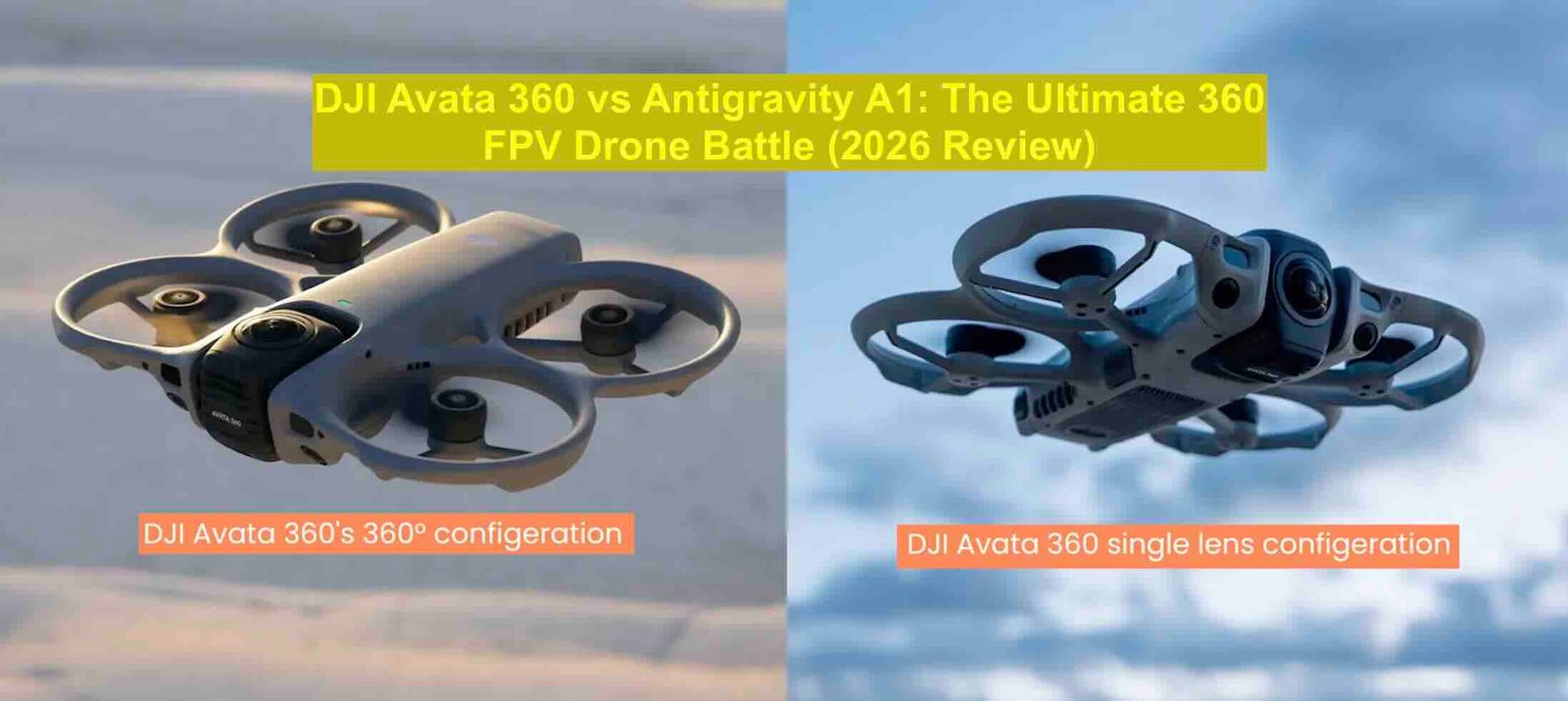
DJI Avata 360 in flight — 8K 360° capture at 60fps
There’s a strange tension in the drone world right now. On one hand, the technology has never been more exciting—we’re seeing AI-driven autonomy, sub-250g portability, and now, a true revolution in immersive capture. On the other hand, if you live in the United States, a shadow looms over every new DJI release.
Enter the DJI Avata 360, the company’s first true 360-degree FPV drone. It’s a device that feels like it’s arriving from two different futures: one where flying cameras become impossibly flexible creative tools, and another where geopolitics means you might not be able to buy the next one.
I’ve spent the last week flying the Avata 360 alongside its most direct competitor—the upstart Antigravity A1 (the world’s first 360° drone, launched December 2025)—to figure out who this drone is for, whether it’s worth the investment, and what its arrival says about where the industry is headed in 2026.
If you’re searching for the best 360-degree FPV drone for creators, or trying to figure out how to buy the DJI Avata 360 in the US despite the FCC ban, this comparison is for you.
What Actually Is the Avata 360?
In simplest terms, think of it as two drones in one body.
The Avata 360 has two high-quality 1/1.1-inch square CMOS sensors mounted on a swiveling gimbal. In 360° Mode, both lenses work together to capture the entire world around you in native 8K at 60fps. You fly without worrying about framing, knowing you can pan, zoom, and reframe your footage in post-production—a game-changer for solo creators.
Flip a switch, and the gimbal rotates one lens forward, transforming the drone into a traditional single-lens FPV flyer, capable of 4K/60fps recording with a classic, cinematic 155° field of view.
This flexibility is its superpower. The Antigravity A1 is locked into 360° mode. The Avata 360 gives you both worlds.
DJI Avata 360 vs Antigravity A1: Head-to-Head Comparison
If you’re shopping for a 360 degree FPV drone in 2026, the choice is essentially between these two. And on paper, DJI has delivered a knockout punch—though not without a few bruises.
Performance & Portability: Speed vs. Sub-250g Compliance
The Antigravity A1’s biggest advantage is its weight. At under 250 grams, it slips under the most restrictive drone regulations in both the US and Europe. It’s also foldable, making it genuinely pocketable—perfect for travelers searching for a sub-250g 360 drone for US pilots.
The Avata 360 is a different beast. At 455 grams, it’s heavier, and its fixed body with built-in propeller guards is bulkier. But that weight brings advantages: it’s tougher, more stable in wind, and significantly faster.
The Verdict: If you prioritize speed, range, and durability, the Avata 360 wins. If you need portability and regulatory flexibility, the A1 is the smarter choice.
🎥 Pro Tip: The “Invisible Drone” Effect
Both the Avata 360 and Antigravity A1 use dual lenses to capture everything around them. With proper editing (stitching and reframing in post), you can create footage where the drone disappears entirely—leaving only the environment. The A1 is famous for this effect, but the Avata 360 achieves it too—with the added benefit of 8K/60fps capture vs. the A1’s 8K/30fps. This means smoother slow-motion and more flexibility in editing.
Left: DJI Avata 360 | Right: Antigravity A1 — two approaches to 360° flight
Camera Quality: 1/1.1-Inch Sensors vs. Smaller Stakes
This is where DJI’s experience shines. The Avata 360 uses two 1/1.1-inch square CMOS sensors, each with an imaging area equivalent to a 1-inch sensor in 4:3 aspect ratio. The result is native 8K/60fps recording with a 200° field of view and a wide f/1.9 aperture.
Compare that to the Antigravity A1, which tops out at 8K/30fps (dropping to 5.2K for 60fps) and uses smaller sensors with a narrower aperture.
In practical terms: the Avata 360 handles high-contrast scenes and low light significantly better. I flew both at golden hour, and the DJI’s 13.5 stops of dynamic range meant I could recover shadow detail that was completely lost on the A1.
| Camera Feature | DJI Avata 360 | Antigravity A1 |
|---|---|---|
| Sensors | Two 1/1.1-inch (64MP each) | Smaller (spec not disclosed) |
| Max Video | 8K/60fps (360° mode) | 8K/30fps (5.2K/60fps) |
| Aperture | f/1.9 | f/2.8 (estimated) |
| Field of View | 200° | ~180° |
| Single-Lens Mode | ✅ Yes (4K/60fps) | ❌ No |
Drone Regulations 2026: Where Can You Actually Fly the Avata 360?
For US Pilots (FAA / Part 107): At 455g, the Avata 360 exceeds the 250g threshold. Recreational flyers must register with the FAA ($5). Commercial flyers need a Part 107 license. And due to the FCC ban, there’s no official US release—you’ll need to buy through importers.
For EU / UK Pilots (EASA / CAA): The Avata 360 carries UK1 and C1 class markings, qualifying for A1 subcategory flights (over people) indefinitely—a key advantage over legacy drones like the Avata 2.
Why Is the Antigravity A1 So Much More Expensive?
At $1,599 for the full bundle, the Antigravity A1 costs nearly $500 more than the DJI Avata 360’s equivalent kit. Here’s why:
- First-mover advantage: The A1 was the world’s first consumer 360° drone (launching December 2025). DJI is playing catch-up and undercutting on price.
- Sub-250g engineering: Fitting a dual-lens 360° camera, flight systems, and a foldable frame under 250g is technically challenging—and expensive.
- Premium headset: The A1’s goggles are considered more comfortable and feature-rich than DJI’s entry-level Goggles N3.
- App polish: Antigravity’s app is currently more stable and user-friendly than DJI’s (especially on Android).
Whether those advantages justify the price gap depends on your priorities. For most users, the Avata 360 offers better value for money—unless you absolutely need sub-250g portability.
💰 Looking for an Antigravity A1 discount? As the newer, premium entrant in this category, the A1 rarely sees sales. However, checking sites like Antigravity’s official store, Adorama, or B&H Photo around major holidays (Memorial Day, Prime Day, Black Friday) may yield small bundle deals or free shipping offers.
Price: A Shocking Value Proposition
| Bundle | DJI Avata 360 | Antigravity A1 |
|---|---|---|
| Drone-only | £409 / €459 (~$540) | Not offered |
| Full Bundle | £829 / €939 (~$1,100) | $1,599 |
The Verdict: Best 360 Degree FPV Drone for Creators in 2026?
Choose the DJI Avata 360 if: You want ultimate creative flexibility, value speed and camera quality, live outside the US (or are willing to import), and want user-replaceable lenses with C1/UK1 compliance.
Choose the Antigravity A1 if: You need a sub-250g drone to bypass registration, portability is your top priority, or you’re in the US and want official support.
For anyone searching for the best 360 degree FPV drone for creators, the Avata 360 sets a new standard. It’s faster, more capable, more repairable, and significantly cheaper than its main competitor.
✈️ Want to avoid strict drone regulations altogether? A sub-250g drone like the DJI Mini 5 Pro or Autel EVO Nano+ might be a better fit for travel and urban flying.
Can You Buy the DJI Avata 360 in the US? (FCC Ban Update 2026)
Here’s the reality for American pilots: DJI is not officially selling the Avata 360 in the United States. The drone received FCC clearance in December 2025—making it the last DJI drone to do so—but the company has no plans for a domestic release.
So how do you get one? Your options:
- Import from Canada or Europe: Retailers in Canada, the UK, and EU countries are shipping to US addresses. Expect to pay $540–$1,100 depending on bundle, plus shipping ($30–$60) and potential import duties.
- Use a forwarding service: Services like Stackry or Planet Express give you a UK/Canadian address that forwards to the US. Add ~10–15% to your total cost.
- Buy from third-party importers: Some US-based shops are quietly importing stock. Search for “DJI Avata 360 US seller” but verify authenticity carefully.
Is it legal to fly once you have it? Yes. FCC clearance was granted, so the drone is legal to operate in the US. You’ll still need to register with the FAA (since it weighs over 250g) and follow standard drone laws.
What about the Antigravity A1? If you want official US support and a sub-250g drone that avoids registration, the A1 remains your only domestically-available 360° option—but you’ll pay significantly more for it.
🔧 The Feature You Didn’t Know You Needed: User-Replaceable Lenses
One of the most surprising—and welcome—features of the Avata 360 is its repairability. The outer elements of both main lenses are user-replaceable. Using a simple tool kit (which costs about $30 / £25), you can pop out a scratched lens and replace it in under five minutes.
In a world where drone repairs often mean shipping the device away for weeks, this is a massive win for both professionals and hobbyists. It’s the kind of thoughtful design that makes you trust a company—and it’s a unique selling point you won’t find on the Antigravity A1.
✨ Why it matters: If you’re flying in tight spaces (as FPV pilots often do), lens scratches are inevitable. With the Avata 360, a $30 repair kit saves you from a $200+ factory repair bill.
Drone Regulations 2026: Where Can You Actually Fly the Avata 360?
🇺🇸 United States (FAA)
The Avata 360 weighs 455g—well above the 250g threshold that exempts drones from registration. What this means:
- Recreational flyers: Must register with the FAA ($5) and display registration number.
- Commercial flyers: Need a Part 107 license for any work-related flights.
- Remote ID: The Avata 360 broadcasts Remote ID natively—no module required.
🇬🇧🇪🇺 United Kingdom & Europe (CAA / EASA)
This is where the Avata 360 has a significant advantage over older drones. It carries:
- UK1 class marking (for the UK)
- C1 class marking (for the EU)
These markings mean the Avata 360 qualifies for A1 subcategory flights—allowing you to fly over people (unintentional overflight) indefinitely. In contrast:
- The DJI Avata 2 has only a C1 mark. From 2028, it becomes “legacy” and will face A2/A3 restrictions.
- The Antigravity A1 (under 250g) flies under the C0 category, which is even less restrictive—no registration, no license, and can fly over people.
Do you need an A2 CofC for the Avata 360 in the UK? No. The C1 classification allows A1 operations without the A2 Certificate of Competency. You still need to pass the Flyer ID and Operator ID tests (free for hobbyists).
| Drone | Weight | Class | EU/UK Category | US Registration |
|---|---|---|---|---|
| DJI Avata 360 | 455g | C1 / UK1 | A1 (over people) | ✅ Required |
| Antigravity A1 | <250g | C0 | A1 (no reg) | ❌ Not required |
| DJI Avata 2 | 377g | C1 only | A1 (until 2028) | ✅ Required |